












Hot Articles
-
Hydraulic Press For Brake Pads
If you need to replace brake pads or align them on your hydraulic disc brake, Park Tool PP-1.2 Hydraulic press is the tool of choice. This wedge-sha……
-
Hydraulic Press Machine Near Me
Hydraulic presses crush, straighten, flatten, and form various materials. They are also used to shape and stamp parts. The concept of a hydraulic pr……
-
How to Make a Hydraulic Press Machine
Hydraulic presses are powerful machines that use liquid as the force transmitter, capable of performing various metal sheet forming processes such……
-
How to Repair Hydraulic Hose Dripping From a Pressed Fitting
By performing regular inspections and following an effective preventive maintenance program, carefully selecting hose and fittings and keeping every……
-
How Much Is a Hydraulic Press?
Hydraulic presses are industrial tools that use a plunger and ram to generate force. The pressure exerted on the plunger is transmitted to the ram b……
-
How to Build a Hydraulic Briquette Press
Hydraulic presses have many uses, from metal production to the assembly of complex electronics components. These devices use pressure in precise a……
-
How Do You Use a Hydraulic Jack As a Press?
Hydraulic jacks are indispensable tools that allow users to lift vehicles or objects onto repair platforms for repair work. Their use involves the……
-
How to Test Hydraulic Presses
Hydraulic presses can be invaluable tools in metal forming and bending applications, offering quieter operations than other metalworking machines ……
Why Were Hydraulic Presses Invented?
time:2023-05-25 views:(点击 1,269 次)
Hydraulic presses use liquid pressure to produce enormous force, using Pascal's principle which states that an enclosed fluid maintains constant pressure. Joseph Bramah invented the first hydraulic press in 1795 - his revolutionary invention enabled greater industrial production.
Joseph also invented pick-proof locks and other devices he employed in his locksmithing business. An accomplished inventor, he also made numerous significant discoveries related to hydraulics.
Blaise Pascal
In 1648, French mathematician and physicist Blaise Pascal made an important discovery that would revolutionize hydraulic power. Pascal discovered that when force is applied to fluid in a closed system, pressure will remain uniform across its entirety - this principle became known as Pascal's Law and forms the cornerstone of all modern hydraulic systems.
Hydraulic presses are indispensable machines on factory floors, used for stamping, forming and pressing purposes. Joseph Bramah introduced the first hydraulic press back in 1795; today this press is often known as "The Bramah Press".
An essential hydraulic press works using two cylinders: master and slave. By exerting moderate mechanical force on either cylinder, they generate greater mechanical forces when compressed together; force created in one inch travel up the master cylinder will increase ninefold!
Joseph Bramah
Joseph Bramah, born 1748 and dying 1814, invented the first hydraulic press (also referred to as a Bramah Press). A hydraulic press uses liquid pressure to convert mechanical power. Bramah's invention stood out because he chose oil over water - which could become corrosive under high loads or evaporate completely - while also realizing its denser nature would allow more powerful hydraulic forces than would water could offer.
Bramah's concept drew upon the same principle discovered by Blaise Pascal: when pressure changes within a fluid that cannot be compressed, the force will spread throughout its system and lead to devices like hydraulic presses and other machines which use liquid pressure as their energy source.
Hydraulic presses feature fewer moving parts than other machines, which makes them safer and simpler to operate. They're also quieter - an essential feature when pressing sensitive materials such as KBr into pellets for FTIR spectroscopy analysis.
Blacksmiths
At home or at a steel mill, hydraulic presses are one of the backbones of industry. From stamping and forming processes to pressing applications, hydraulic presses play an essential role.
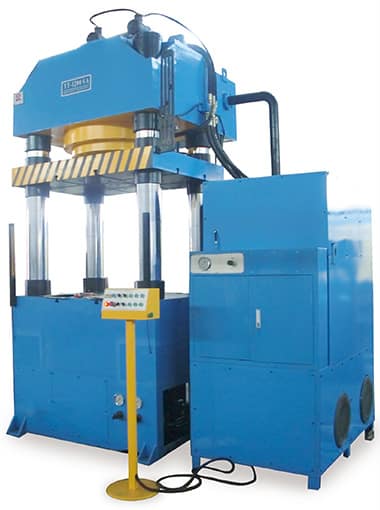
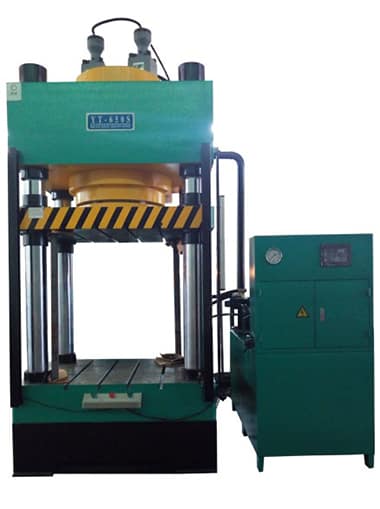
A four column hydraulic press function similarly to any other hydraulic system: a master cylinder connected via pipes is connected to a slave cylinder with smaller dimensions and piston. Applying force to either of these cylinders causes fluid from them to flow back to be compressed by the master cylinder for greater force output.
Bramah invented his first hydraulic press in 1795 and started the industrial revolution by allowing manufacturers to automate machinery such as printing presses and cranes. He replaced water with oil due to its non-corrosive properties; higher loads can be handled more safely, and high pressure forces do not cause its evaporation resulting in quieter modern hydraulic presses than their predecessors.
Agriculture
Hydraulic presses have many uses across various industries. From sword making to creating fat-free cocoa powder, hydraulic presses provide immense amounts of force and pressure in their work. Furthermore, these presses can also be found at junkyards or car factories where assembly lines use hydraulic presses as part of their assembly lines.
Joseph Bramah came from a yeoman farmer family in northern England. As part of his experimentation, Joseph found that liquid power could be harnessed using cylindrical seal-fit cylinders sealed with leather seal-strips sealed by self-tightening collars to form hydraulic presses.
Today's hydraulic presses are designed to fit easily into most facilities. Their reduced number of moving parts reduces potential points of failure while eliminating special safety equipment - making them a more cost-effective solution than other forms of machinery. Plus, they produce equivalent power in half the space; helping your company reduce carbon emissions while increasing efficiency.
Link to this article: https://www.ihydraulicpress.com/mk/3142.html
Hot Articles
-
Hydraulic Press for Gearbox Repair
Hydraulic presses are a ubiquitous piece of machinery in the manufacturing industry. They’re useful for numerous tasks such as bending, formin……
-
Can You Use a Hydraulic Press to Harden Water?
A hydraulic press is a machine that utilizes hydraulic fluid to generate and transfer force. Pascal’s law dictates that exerting force upon ……
-
Hydraulic Press for Aircraft Repair
Hydraulic presses are essential tools in aircraft repair. They can straighten shafts, press out bearings and free rusted parts from their frames. Ma……
-
Hydraulic Press Videos – Can a Hydraulic Press Crush a Diamond?
Hydraulic press videos are a wildly popular Internet trend. They demonstrate various objects being crushed in a hydraulic press and often garner mil……
-
Hydraulic Press for Hydraulic Fitting Repair
Hydraulic presses are widely used in a range of industries and applications. They’re typically employed to press two materials together or str……
-
Hydraulic Press for Hydraulic Hose Repair
Hydraulic presses are versatile pieces of machinery used in various industries such as food production, cosmetics manufacturing and blacksmithing. P……
-
Hydraulic Press For Blacks
A hydraulic press is a machine that uses fluids to exert mechanical forces on objects. These presses are used in a wide range of industries. One com……
-
How to Make Your Own Hydraulic Juice Press
Hydraulic juice presses are cold-press juicers that use pressure instead of heat to extract juice, keeping more vitamins and enzymes intact to pro……
Latest News
-
Hydraulic Press for Generator Repair
Hydraulic presses are versatile machines that help compress materials such as metal, plastic and concrete. Hydraulic presses can also be utilized fo……
-
Hydraulic Press for Glass Bottle Recycling
Hydraulic presses are essential tools in the manufacturing process for many industries, compressing and shaping materials into desired shapes. They&……
-
What Hydraulic Press is Used For
The hydraulic press is a machine that generates power by compressing or straightening metal pieces. It finds application in numerous industries. Hyd……
-
Various Applications for a C Frame Hydraulic Press
Various Applications for a C Frame Hydraulic Press C frame hydraulic presses are versatile metalworking tools that form a “C” shape arou……
-
What is Hydraulic Press in Physics?
Hydraulic presses are machines that utilize pressure to compress material. They’re commonly employed for forging, clinching, stamping and blan……
-
How Does the Hydraulic Press Work?
Hydraulic presses are employed for a variety of tasks. Auto manufacturers rely on them to manufacture body panels and brake pads. They’re also……
-
How to Build Hydraulic Press Bottle Jack
To build a hydraulic press bottle jack, you will require an appropriate-sized jack that can apply pressure – most car-lifting jacks have 5 t……
-
Hydraulic Press for Hydraulic Valve Repair
Hydraulic presses are widely used across a range of industries due to their versatility and adaptability to meet different production and assembly r……